
Do Activated Carbon Filter Tips Really Reduce Tar? Here’s What Smokers Should Know
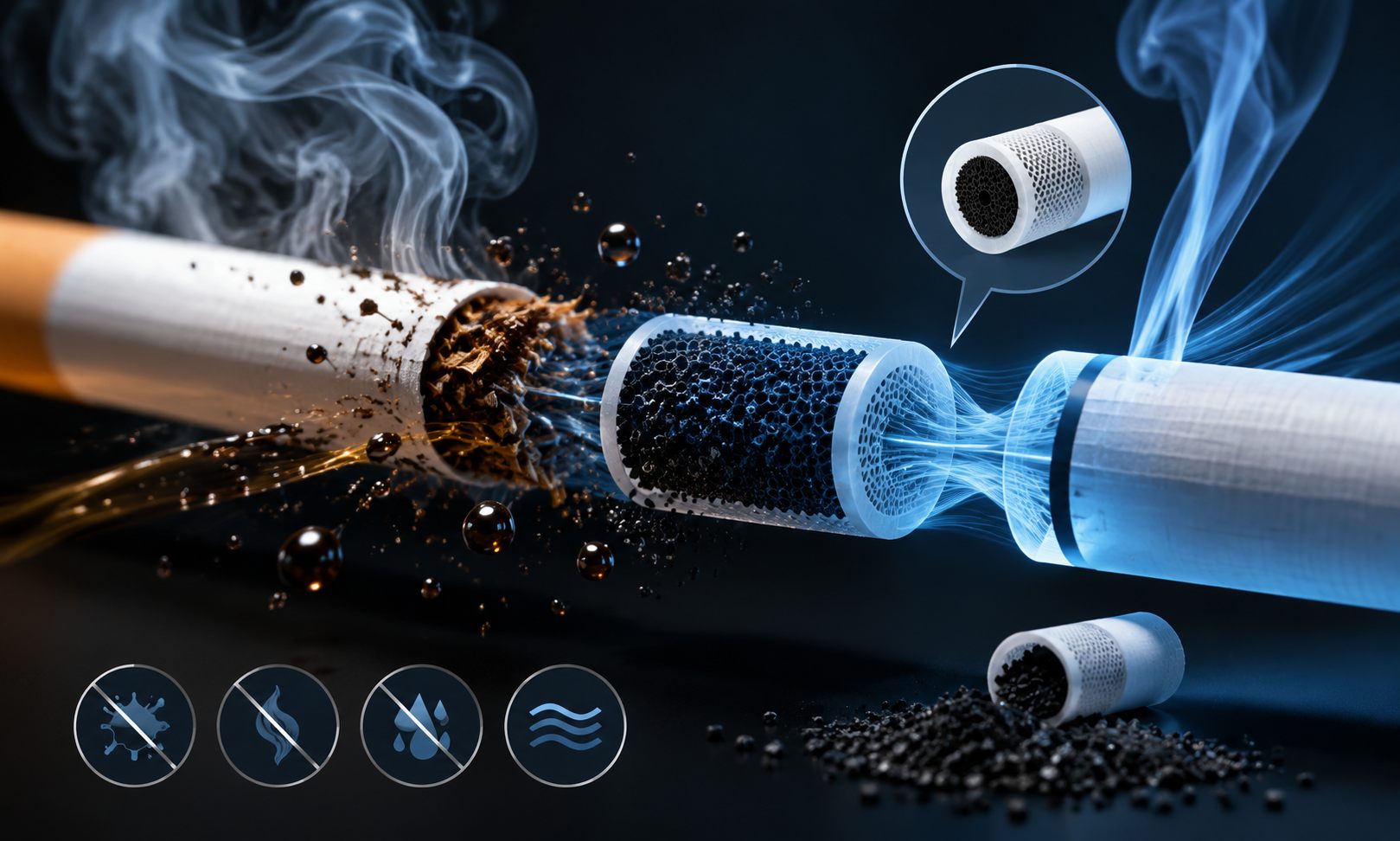
Activated carbon filter tips can change the chemical profile of cigarette smoke, but the common claim that they “remove tar” needs careful qualification. Activated carbon is better at adsorbing certain gas-phase compounds than capturing the particulate material commonly reported as tar. Laboratory reductions also do not prove a lower disease risk for the person smoking. Smoking remains harmful, and no cigarette filter makes combustible tobacco safe. For manufacturers, distributors, and adult consumers, the useful questions concern what the carbon can adsorb, how the tip is constructed, how results are measured, and which claims are legally and scientifically supportable.
Do activated carbon filter tips actually reduce tar?
They may reduce machine-measured tar modestly in some designs, but tar is not the fraction activated carbon handles most effectively. Tobacco tar is the particulate residue created when tobacco burns and contains many harmful substances. In laboratory work led by FDA and CDC researchers, adding charcoal produced large reductions in several carbonyl compounds while tar and nicotine changed by less than 20 percent, even at the highest charcoal loadings tested.
Why is the answer different for gas and particles?
Cigarette smoke contains both a gas-vapor phase and a particulate phase. Activated carbon has a porous surface that can adsorb selected volatile compounds as smoke passes through the filter. Studies have reported reductions in substances such as formaldehyde, acrolein, benzene, and 1,3-butadiene, while particulate-phase markers often changed much less.
The practical conclusion is narrow: a carbon tip can alter delivery of certain smoke constituents under defined test conditions. It should not be described as removing all tar, all toxins, or the overall danger of smoking.
What determines how well an activated carbon tip performs?
Carbon quantity matters, but it is only one variable. Adsorption also depends on carbon type, pore structure, contact time, smoke volume, filter layout, moisture, and how tightly the user draws. A small amount dispersed through ordinary filter material may behave differently from a cavity filled with a larger carbon charge.
Why do carbon loading and draw conditions matter?
Research on commercial charcoal-filter cigarettes found that volatile organic compound reduction varied with both carbon quantity and the volume of smoke pulled through the filter. Under more intense smoking conditions, lower carbon loads could become saturated, allowing compounds to pass through. Higher carbon loading reduced this breakthrough, although it still did not convert the product into a low-risk cigarette.
Tip dimensions also affect draw resistance and user experience. Adding more adsorbent without redesigning airflow can make the cigarette harder to draw, encourage stronger puffing, or change combustion behavior. Product development therefore requires balancing carbon mass, pressure drop, tip length, ventilation, and structural stability rather than maximizing one specification.
Why can laboratory results differ from a smoker’s actual exposure?
Smoking machines follow fixed puff volumes, intervals, and durations. People do not. They may take deeper puffs, smoke more frequently, cover ventilation holes, or change the number of cigarettes consumed when a product delivers smoke differently. NCI notes that machine-measured reductions in tar do not reliably predict how much tar a smoker inhales, and “light” cigarette designs have not reduced smoking-related disease risk.
Can a lower machine yield support a safer-cigarette claim?
No. FDA restricts unauthorized claims suggesting that a tobacco product is safer, less toxic, or lower risk. Terms such as “light,” “low,” and “mild” are prohibited in U.S. cigarette marketing without the required modified-risk authorization, and FDA has taken action against filter products promoted with unapproved tar-reduction or safety claims.
This distinction is essential for private-label projects. A supplier may provide machine-test data for a specific tip and cigarette configuration, but the brand remains responsible for how that evidence is presented. A statement about measured constituent delivery is not the same as evidence of reduced disease risk.
How should buyers evaluate activated carbon cigarette tips?
Professional buyers should begin with the intended cigarette format and test the finished combination, not the loose tip alone. Tobacco blend, paper permeability, filter ventilation, cigarette circumference, carbon loading, and base filter material can all change the measured result.
Which specifications and inspections matter?
A purchasing specification should define tip length, diameter, pressure-drop range, carbon type and mass, base filter material, ventilation pattern, wrapper construction, moisture limits, and dimensional tolerances. Incoming inspection may include dimensions, weight, draw resistance, carbon distribution, bond integrity, odor, appearance, and packaging condition.
Smoke testing should use a declared method and the final cigarette design. Reports need to identify the sample, conditioning procedure, smoking regime, measured constituents, number of replicates, and laboratory. Without those details, buyers cannot compare results across suppliers or determine whether later production matches the approved sample.
What production risks deserve attention?
Uneven carbon filling can create variable draw resistance and inconsistent adsorption. Loose particles may migrate, poorly bonded segments can separate, and moisture pickup can alter storage behavior. Packaging must limit crushing, contamination, and humidity exposure during transportation.
Buyers should also establish batch codes, retained samples, defect limits, and change-notification rules. A change in carbon source, particle size, filter material, adhesive, or ventilation pattern may require renewed qualification even when the external dimensions remain the same.
What should smokers and brands conclude about health risk?

Activated carbon filter tips can reduce selected gas-phase toxicants in controlled tests, yet they do not remove the full mixture of harmful chemicals created by tobacco combustion. WHO states that all forms of tobacco use are harmful and that there is no safe level of exposure. NCI likewise advises that filtered or low-tar cigarettes do not lower the risks of cancer and other smoking-related diseases.
What is the most accurate consumer message?
The accurate message is that carbon filtration may change measured smoke chemistry without making smoking safe. Claims should be limited to evidence from the exact tested design and should not imply protection from disease. For smokers concerned about tar or toxin exposure, stopping smoking provides a meaningful reduction in health risk; changing filter tips does not offer an equivalent benefit.
How can a cigarette tip supplier support product development?
Bella420facto-smoking accessories co.,ltd. supplies cigarette tips for brands, distributors, and smoking-accessory buyers. For activated carbon filter tip projects, buyers can submit required dimensions, carbon loading, draw-resistance range, base filter structure, ventilation design, packaging, and order quantity. Sample evaluation should confirm fit, airflow, carbon distribution, segment bonding, odor, and storage condition before production. Any smoke-constituent testing should use the final cigarette configuration and a clearly identified method. Quotations should state specifications, tolerances, packaging, lead time, inspection criteria, and change-control terms. Buyers should document approved samples for repeat-order comparison and remain responsible for verifying product legality, labeling, marketing claims, and market-specific tobacco regulations.
Вывод
Activated carbon filter tips can reduce certain volatile and gas-phase smoke constituents, but their effect on tar is generally more limited and depends on the complete cigarette design and test conditions. Machine results cannot establish that a smoker receives lower exposure or faces less disease risk. Buyers should control carbon loading, pressure drop, dimensions, production consistency, testing methods, and marketing language. Smoking remains harmful, and quitting—not changing filters—is the reliable way to reduce smoking-related health risk.
Часто задаваемые вопросы
1. Do activated carbon filter tips remove all cigarette tar?
No. Activated carbon mainly adsorbs selected gas-phase compounds. It may produce a modest change in machine-measured tar, but it does not remove all particulate matter or harmful smoke constituents.
2. Are activated carbon cigarettes safer than regular cigarettes?
There is no basis for treating them as safe. Changes in measured smoke chemistry do not establish reduced cancer, cardiovascular, or respiratory risk, and smoking any combustible cigarette remains harmful.
3. Why can two carbon filter tips produce different results?
Results vary with carbon quantity, pore characteristics, filter structure, ventilation, pressure drop, cigarette design, smoke volume, and testing method. The final assembled cigarette must be evaluated rather than the tip alone.
4. What should buyers request from an activated carbon tip supplier?
Request dimensional drawings, carbon specifications, pressure-drop tolerances, material information, batch controls, packaging details, samples, inspection criteria, and test reports tied to the exact finished cigarette configuration.
5. Can brands advertise an activated carbon tip as low tar?
Such claims can be restricted or require authorization, depending on the market. Brands should obtain legal review and avoid wording that implies reduced harm unless regulators have specifically permitted it.
РЕГИОНЫ МИРА


